|
NEW
PUBLICATIONS
 New
book is published: New
book is published:

Shapkin О.А., Babushkin М.V. 2025. Who are you, children of the night? Essays about bats of the Vologda Lakeland. Cherepovets, CPC. 312 с.
[In Russian with English summaries for all chepters]
New
book is published:
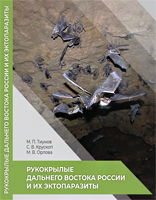
Tiunov M.P., Kruskop S.V., Orlova M.V. 2021. Bats of the Russian Far East and their ectoparasites. Moscow, "Pero". 191 p. [in Russian]
|
SCIENTIFIC
NEWS
Scabies mite from the family Sarcoptidae associates with bats was for the first time recorded in Russia by V.B. Kolesnikov and M.V. Orlova. The new species was described named Notoedres alinae sp. n.; it is associated with Myotis ikonnikovi (Kolesnikov, Orlova, 2026; Acarologia, 66(2); DOI: 10.24349/kzn1-ogpv)
A.D. Botvinkin et al. by the examination of bat feaces with micromorphological and molecular approach revealed presence of four endemic Baikal amphipods in the diet of Myotis petax. Eastern water bat feeds on amphipods catching them during their periodic nocturnal ascents to the water surface. (Botvinkin et al., 2025; Russian J. of Theriology, 24(2); DOI: 10.15298/rusjtheriol.24.2.01).
S.S. Zhukova et al. study phylogenetic relationships within the "true" pipistrelles of the tribe Pipistrellini, using six genetic markers. All data support the paraphyly of the genus Pipistrellus, leading to the separation of the "eastern" clade of pipistrelles into a separate genus, Alionoctula (represented in the Russian fauna by A. abramus). It was shown that A. abramus occupies the most distinct position within the genus and deserves consideration as a separate species group. The contradictory position of the lineage of Pipistrellus nathusii, combined with certain morphological differences from other Pipistrellus, allows it to be considered within a separate subgenus, Nannugo. (Zhukova et al., 2025; Diversity, 17(5); DOI: 10.3390/d17050317).
A.S. Speranskaya et al. obtained a complete sequence of a new species of mastadenovirus from the feaces of the common noctule, Nyctalus noctula, from the European part of Russia. The new virus is not similar to the mastadenovirus type B common among European bats; its related lineage has so far been isolated only from vespertilionids of Australia (Speranskaya et al., 2024; Viruses, 16(8); DOI: 10.3390/v16081207).
D.G. Smirnov and A.V. Zabashta examined the features of the winter distribution of the common noctule, Nyctalus noctula, and the factors that determine it. It is proposed to divide the winter range of the noctule into a main zone, where wintering is massive and possible in natural roosts, and a "risk zone", where a small part of the population can winter only thanks to anthropogenic roosts (urban buildings) (Smirnov et al., 2023; Russ. J. Biological Invasions, 2023(3); DOI: 10.35885/1996-1499-16-3-168-183).
S.S. Zhukova et al. obtained the first complete mitochondrial genome of the Indochinese thick-thumb pipistrelle, Glischropus bucephalus. Phylogenetic analysis using complete mitogenomes once again confirms the paraphyly of the genus Pipistrellus in its modern understanding (Zhukova et al., 2023; Diversity, 15(1085); DOI: 10.3390/d15101085)
A.P. Yuzefovich with co-authors published an article about diversity of the Hipposideros larvatus species complex across mainland South-East Asia, analyzed on the basis of molecular (two mitochondrial and seven nuclear markers) and morphometric data. Presence of at least four species-level lineages were shown (Yuzefovich et al., 2022; Zootaxa, 5200(1))
M.P. Tiunov et al. describe a first record of the Anderson's serotine (Eptesicus pachyomus) in the south of Primoriye, adding a new bat species to the Russian fauna (Tiunov et al., 2022; Zoologicheskiy J., 101(12))
|